Showing posts with label sonicwallpaper. Show all posts

Thursday, 22 March 2012

Vintage sounds of dentistry at the British Dental Asssociation Museum

A few weeks ago I visited Birwood Dental Care to record the sounds of dental instruments in action. Last week, I expanded on this collection of historic dentistry sounds by visiting the British Dental Association Museum where Melanie Parker - who runs the education and outreach programme at the Museum - kindly demonstrated the use of many of the objects in the collection so that I could hear them. These recordings relate to comments made by interviewees earlier in the Sonic Wallpaper project, and will be used to animate the fantasies and imaginings which looking at the MoDA wallpaper collections inspired.


Ivory dentures and denture brush photographed by Felicity Ford with the kind permission of the BDA Museum

The objects in the BDA Museum are fascinating, ranging from dentures made from vulcanite and porcelain or ivory through to intricate sets of instruments and elaborate cases for tooth-picks. I was intrigued to learn about the relationships between privilege, status, and the care of one's teeth, and to see how the objects and rituals associated with dental health have evolved over the past couple of hundred years. There is much social history to be gleaned from exploring the collection at the BDA Museum. For instance, the ivory dentures photographed above have holes at the front in order to put pins into to then attach real human teeth. Such teeth were often taken from dead soldiers, and were known as ‘Waterloo teeth' because of the plundering of soldiers' bodies for teeth which took place following the Battle of Waterloo.

It will probably not surprise you to learn that I was principally interested in objects in the collection which might produce recordable sounds, such as a foot-treadle dental engine invented by James B Morrison in 1871. According to the BDA Museum's article on the history of dental drills "this foot operated machine based on the principles of the treadle sewing machine achieved 2000 rpm greatly increasing the rotation speed [of the spinning drill bit]." I don't know about you, but I find this an infinitely more soothing sound than that of our modern-day dentist's drills!


I made several other recordings of historic dental drills, including a 200-year-old hand drill, the operations of which I documented with both a contact microphone blu-tacked onto the dentures which were being drilled, and with a stereo shotgun microphone pointing at the table where Melanie was operating the drill.


The reason for this elaborate set-up is that when we are at the dentist's, we mostly hear the sounds of what happens as vibrations conducted through the bones in our head. Contact microphones work by picking up on vibrations of sound as they travel through matter, and I hoped that in recording the sounds of a dental drill using contact-microphones, I might be able to simulate the way that we hear dentistry in our own mouths. The results are appropriately scratchy and uncomfortable to listen to, and are unsurprisingly very different from the recordings I made using a stereo shotgun microphone.


De-accessioned dentures containing human teeth photographed by Felicity Ford with the kind permission of the BDA Museum

I think you can hear a lot more of the teeth and the drilling action in the contact microphone recording (above) and more of the rattly mechanism of the 200 year old Finzi hand drill in the stereo shotgun microphone recording (below).


Finzi hand drill photographed by Felicity Ford with the kind permission of the BDA Museum

The sound of squeezing toothpaste out of a tube is almost completely inaudible, but in the past when dentifrice or toothpaste were supplied in tins or ceramic pots, the sounds associated with beginning and ending everyday tooth-brushing rituals were quite different from today.


Cherry toothpaste pot photographed by Felicity Ford with the kind permission of the BDA Museum


Dentifrice tin photographed by Felicity Ford with the kind permission of the BDA Museum

Another sound which I found especially interesting to compare to its contemporary counterpart is the sound of the wooden dispensary chair. This was a piece of apparatus designed to tilt a patient's head backwards so that the dentist could get at their teeth. It is creaky and wooden, and does not purr or beep like its electronic, modern-day equivalent! For both my recording of the chair at Birwood Dental Care and the BDA Museum, I used binaural microphones to record the motions of the chair. The reason for this is that I think one always hears this sound from the perspective of being a patient; of stepping up into the dentist's chair, sitting down on it, and being compelled by its movements to lie back. I've put the two recordings here side by side, so that you can compare them.

Both recordings were made with a set of SP-TFB-2 - Sound Professionals - Low Noise In-Ear Binaural Microphones connected to an Edirol R-09. I discovered these microphones through the wonderful Binaural Diaries of Ollie Hall.


From the point of view of the Sonic Wallpaper project, these recordings are very interesting as the more modern dentist's chair undeniably has an association with converted old houses and thickly-overpainted textured wallpaper, whereas I have no memories or associations with the sounds of the dispensary chair, and therefore no way of visualising what kind of space it would originally have been used in. I imagine it is unlikely that there would have been wallpaper in the rooms in 1800s Britain where the treadle-operated foot drill or the dispensary chair were originally put to use, but I am not really sure. Any ideas, anyone?

My favourite recording from the BDA Museum adventure is definitely the contact-microphone recording, as I think it is visceral and uncomfortable in just the way that having a drill working away at your own your teeth can be. I am not sure yet how I will use this sound in a Sonic Wallpaper, but it relates to a wallpaper design which made some of my interview participants very uncomfortable, and so I feel it to be an appropriate sound for the project on several levels.

I'm also rather fond of this recording, which was made using an old set of dentures made of vulcanite with porcelain teeth, and a denture-cleaning brush. Melanie explained to me that for a long time a roll and flick motion was prescribed as the finest approach to cleaning your teeth, and as you can hear this produces a very particular rhythm.


Many thanks to the BDA Museum for all your help recording these sounds of historic dental tools in action. Stay tuned to see how they shall be incorporated into the forthcoming Sonic Wallpaper designs.

ETA: Melanie Parker read this article and has the following comments on the links between dentistry and wallpaper:

I think the dental dispensary probably would have been rather stark because it was where the urban poor went for treatment. The foot drill, however, could be associated with wallpaper. As far as we can tell it would have been used by a wide-range of practitioners i.e. those working in dental dispensaries and dental hospitals treating the poor, pharmacists who also undertook dentistry or whom the dentist visited (some foot drills could be broken down and put in a wooden case – suitcase style – to be easily transported) and by high-class dentists who of course would have had very nice surgeries with plush wallpaper.


Thank You, Melanie.

Monday, 19 March 2012

Listening to Dr Johnson's House


Dr Johnson's House, photographed by Felicity Ford with the kind permission of Dr Johnson's House Trust

Last week I visited Dr Johnson's House in order to record some sounds for the production of Sonic Wallpaper.

I was after creaks; old sash windows opening and closing; groaning doors; the sounds of old stairs; inky writing; pages being turned; and other sounds evoking The Past and Writing.

This may seem anachronistic, but in visual wallpaper designs ordinary tastes have often been somewhat nostalgic and to my mind it makes sense that my sonic project follows suit. In Little Palaces, house and home in the inter-war suburbs, I read that in the early 1920s when the first home-decoration journals in the UK appeared, those journals "sang the praises of the old and the antique", and these days one only has to look at how the past inspires contemporary designs - think of the 1950s-esque Cath-Kidston prints which are so popular at the moment - to see that there often seems to be a kind of nostalgia for a golden past inhabiting our home-decoration fantasies.

Accordingly, I have been asking myself the question what does sonic nostalgia sound like? And how could we decorate our homes sonically to recall the past in sounds in the same ways that we do with visual designs, patterns and colour-schemes? One way I can think of involves recording the sounds of old interiors, and finding simple ways of introducing such sounds into modern interiors. For instance, I could give you this sound, which you could play right now in your own home, momentarily experiencing the creakiness of doors which may - or may not be - older than the ones you currently have installed. Is deliberately introducing this sound from the past into your home any different from buying old things or nostalgic furnishings or textiles with which to adorn your home? How could you make the sound a semi-permanent feature, like wallpaper?


Dr Johnson's House is over 300 years old and has been furnished simply, retaining many surviving early features from wooden floorboards and panelling to its creaky, open staircase.


Staircase at Dr Johnson's House photographed by Felicity Ford with the kind permission of Dr Johnson's House Trust

This means that the building is full of sounds which cannot be heard in an environment which has been modernised inside. The stairs, for instance, do not sound like modern stairs, and the building is a treasure trove for nostalgic and historic noises...


...It is however never possible to completely evoke the past in sounds, because even in the quiet recess of Gough Square where Doctor Johnson lived and worked as a writer in the 1700s, the sounds of the modern world pervade. Infiltrating the red bricks and insinuating their way through the beautiful, warped glass of the windows, today's sounds announce the presence of aeroplanes, street traffic, mobile phones and other sonic indications that we now live in 2012.


Window in Dr Johnson's House photographed by Felicity Ford with the kind permission of Dr Johnson's House Trust

In this recording, for instance, you can hear the sounds of the old window and wooden shutters being opened onto the square below, and then a spate of sounds from the quiet, contemporary London backstreet outside drifting upwards.


One of the interviewees who consulted the MoDA wallpaper collection as part of the Sonic Wallpaper project discussed her dream of one day having a small writing garrett which she would decorate with said wallpaper.


Dr Johnson's Garrett photographed by Felicity Ford with the kind permission of Dr Johnson's House Trust

Dr Johnson's Garrett is not exactly small, but he did compile a dictionary there, and I felt the creaky qualities of the building plus its writerly connotations would befit my friend's speculations on her yearned-for writing room.


I therefore sat at the old wooden table leafing through a facsimile copy of Dr Johnson's Dictionary, recording the sounds of writing with a fountain pen on a thick piece of paper, and researching the etymology of the verb "to record" in Johnson's own book.


Facsimile edition of Dr Johnson's Dictionary photographed by Felicity Ford with the kind permission of Dr Johnson's House Trust


The last sound which I recorded at Dr Johnson's House was the impressive sound of the door locking mechanism; a long, heavy chain on a twisty bit of metal, and a rather serious looking bolt. You can hear them below!


It is a pity that Hodge - Dr Johnson's favourite cat - is no longer around, as my friend discussed how important the sound of cats disturbing and playing in her piles of papers would be as a sonic detail in her writing room, and I would have liked to have spent some time with this handsome feline, encouraging him to disarrange my handwritten papers in order to record the sound of this occurring.


The statue of HODGE outside Dr Johnson's House photographed by Felicity Ford with the kind permission of Dr Johnson's House Trust

I wonder if Hodge ever disturbed Dr Johnson's papers, knocking them to the floor with a brittle swoosh, and I wonder how far back in time writers have been listening to the antics of their cats in the contemplative quiet of their homes?

What sounds do your cats introduce into your homes, and what would you consider to be a nostalgic sound which you would like to hear regularly in your home?

Thanks very much to the Dr Johnson's House Trust for making these recordings possible, and stay tuned to see how they might become "sheets" of Sonic Wallpaper. For more information on Dr Johnson, on his dictionary and on Hodge, see the official website here.

Wednesday, 14 March 2012

Learning Resources

I am developing a worksheet for our Learning Resources page. This page will hold a continually expanding archive of sounds and worksheets so that students can extend the Sonic Wallpaper project in your own way, and bring some of the ideas held here into your own practices.

The first worksheet is called "Textured Wallpaper" and deals with the audio generated by interviewing people about this wallpaper:


Wallpaper © Museum of Domestic Design & Architecture, Middlesex University – photographed by Felicity Ford

One person commented that - as a child - looking at paper like this would often inspire a fantasy of travelling through it. The idea of tracing a journey through the interweaving lines was inspired by the surface and the pattern, which become a bewildering maze as soon as one tries to traverse it in this way.

Another person described this wallpaper as being "serviceable" echoing the perspective of another interviewee, who commented that this sort of textured design "lasts forever".

There was much conversation regarding the kinds of environment - Edwardian house; Pub; Corridor - where such a design may be seen.

One person even spoke of wishing to colour it in, though - naturally - the rules surrounding the conservation of historic wallpaper samples at MoDA prevented anyone from acting on this!

The paper also inspired much speculation on the appeal of papers like this to children. Everyone who remembered such a paper from their childhood fondly recalled their obsession with picking at its embossed surface.

In terms of how I might develop these bits of conversation into Sonic Wallpaper, there are many options including recording the sounds of all things mentioned in the interviews:

painting wallpaper - the sound of a roller going over and over a piece of wallpaper, to make sure it gets into all the cracks
walking down a long, Edwardian corridor, possibly lined with tiles
chatter in an old pub somewhere in the South East end of London
colouring pencils colouring
the secretive sound of peeling bits of wallpaper off a wall

...then there is the somewhat more complex task of trying to create a sonic equivalent of this paper; i.e. a sound which would act as this paper acts, as a durable, lasting bit of texture which makes a room slightly less plain than a painted wall, and which inspires fantasies of travelling on paper, or the fear of overfussing things.

What on earth would such a sound sound like?

If you want to explore these ideas yourself, you can download all the sounds and the worksheet to help you through the process here! Happy Sonic Wallpapering!

Thursday, 19 January 2012

Editing notes

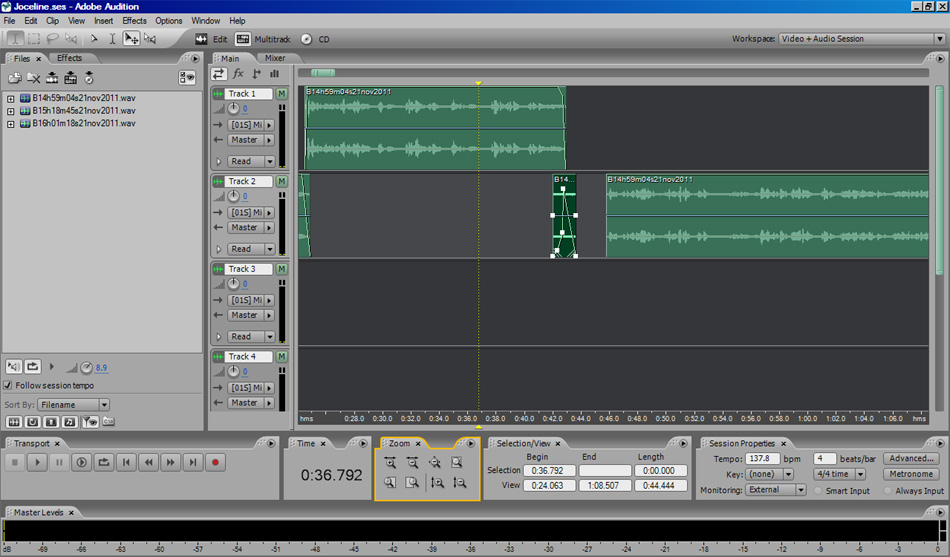
I am currently spending a lot of time walking and listening, and editing and listening.

This is what I can see when I am editing:


...and today, this is what I can hear:

Sonic Wallpaper Sample #1 by FelicityVFord

The words and thoughts of the interviewee make me think of the sounds of:

small rooms
creaky chairs
harp-strings
the sound of a tissue-box guitar, made with rubber bands
looms clacking

...all organised into a repetitive, minimalist composition. Lots of little sounds, repeated over and over, in a calming yet quite busy sequence. What sounds does this interviewee put into your head?

And which of the papers below do you think this small soundbyte relates to? Leave a comment to share your thoughts.


Wallpapers, shortlisted for Sonic Wallpaper interviews. Wallpaper © Museum of Domestic Design & Architecture, Middlesex University – photographed by Felicity Ford