Showing posts with label sounds. Show all posts

Wednesday, 14 March 2012

Learning Resources

I am developing a worksheet for our Learning Resources page. This page will hold a continually expanding archive of sounds and worksheets so that students can extend the Sonic Wallpaper project in your own way, and bring some of the ideas held here into your own practices.

The first worksheet is called "Textured Wallpaper" and deals with the audio generated by interviewing people about this wallpaper:


Wallpaper © Museum of Domestic Design & Architecture, Middlesex University – photographed by Felicity Ford

One person commented that - as a child - looking at paper like this would often inspire a fantasy of travelling through it. The idea of tracing a journey through the interweaving lines was inspired by the surface and the pattern, which become a bewildering maze as soon as one tries to traverse it in this way.

Another person described this wallpaper as being "serviceable" echoing the perspective of another interviewee, who commented that this sort of textured design "lasts forever".

There was much conversation regarding the kinds of environment - Edwardian house; Pub; Corridor - where such a design may be seen.

One person even spoke of wishing to colour it in, though - naturally - the rules surrounding the conservation of historic wallpaper samples at MoDA prevented anyone from acting on this!

The paper also inspired much speculation on the appeal of papers like this to children. Everyone who remembered such a paper from their childhood fondly recalled their obsession with picking at its embossed surface.

In terms of how I might develop these bits of conversation into Sonic Wallpaper, there are many options including recording the sounds of all things mentioned in the interviews:

painting wallpaper - the sound of a roller going over and over a piece of wallpaper, to make sure it gets into all the cracks
walking down a long, Edwardian corridor, possibly lined with tiles
chatter in an old pub somewhere in the South East end of London
colouring pencils colouring
the secretive sound of peeling bits of wallpaper off a wall

...then there is the somewhat more complex task of trying to create a sonic equivalent of this paper; i.e. a sound which would act as this paper acts, as a durable, lasting bit of texture which makes a room slightly less plain than a painted wall, and which inspires fantasies of travelling on paper, or the fear of overfussing things.

What on earth would such a sound sound like?

If you want to explore these ideas yourself, you can download all the sounds and the worksheet to help you through the process here! Happy Sonic Wallpapering!

Thursday, 2 February 2012

Places and Sounds

I have been immersed in listening to the wallpaper samples, and thinking about where I might record relevant sounds, and where the wallpaper samples might be displayed. The whole experience is making me think in more depth about the extreme specificity of sound.

For instance I mentioned in an earlier post, my need to identify the right kind of clock to accompany a particular wallpaper. So many ideas which were discussed re: the wallpaper - the idea of repetition and delicacy in the pattern - could be sonically evoked, I felt, by finding exactly the right kind of clock tick-tocking. I defined that this exact sound would need to be small and unobtrusive, yet detailed, and also warm and comforting, as these were exactly the characteristics attributed to the wallpaper design in question. I cited The Clockmaker's Museum as a potential location for exhibiting this wallpaper sample, and sourcing the distinctive clock-ticking sound which I now seek.

It may seem that I am over-fussing the issue of what kind of clock to record, but to illustrate the massive differences between one kind of clock and another, I want to share some of the wonderful samples of clock sounds which I came across on Freesound.org. We shall begin with this example, which was recorded by Reinsamba.


I love the musical quality of this clock sound and the bouncing quality of its mechanism. It is identified as being a 1960s clock; I couldn't be that specific just from listening, but it definitely sounds different from a contemporary clock. The recording has a certain intensity about it, owing to how close the microphone seems to be to the clock; it is as though we are scrutinising the sound, and the volume is much louder than it would be if we were sat some distance away, say on an armchair a couple of metres away from the mantelpiece where I presume this clock sits. Because the microphone is so close to the clock, it is hard to picture the space around it, but the lovely detail of the sound is still very distinctive and I imagine immediately evocative for anyone who ever owned a clock which sounded precisely like this.

Contrastingly, this recording - recorded by daveincamas - is much more readily identifiable as being the sound of a much older clock. We hear mechanisms, delicate springs, a balance of components inside the object not normally heard today. In a sound piece, it would instantly bring in an atmosphere of early 1900s or perhaps an even earlier time, and it has a slightly arcane quality about it.


Suffice to say, it is insufficient for my purposes to say "I need to record the sound of a clock" when considering the way I want to develop the wallpaper interviews with sound-recordings. Where is the clock? Of what era is its mechanism? Where is the clock situated? How far should my microphone be with it? What else will we be able to hear? What purpose will the sound serve in the piece? Each layer of a sound is an extra subtext of information about place, time, and history, so that when we hear a clock we also hear the timbre of the room in which it was ticking; the kinds of materials of which it is comprised; and - to a certain extent - the era in which it was made.

Yet in spite of this specificity of sounds, for some reason - (at least this is something which I have observed)- the notion that sound-recordings are all interchangeable still pervades. I wonder if this is because of the prevalence of sound effect libraries? I have no problem with sound effects libraries at all; I understand that there are complications around using recordings made in public spaces for things like film-scores, and that the ungovernable nature of many environments mean that if you want a particular sound, the best way to ensure that you capture it, is in a controlled studio setting. There is a practical problem, too, from the point of view of creating sound effects or sound tracks for films, which is background noise. Precisely because of all the information which is contained in background noise, it can complicate screenplay, and "cleaner" sounds are necessary. How confusing would it be to watch a period drama, for instance, and to suddenly be aware of the sounds of 21st century traffic in the background? And where can one record anywhere in the world today without that pervasive sound of traffic, unless it is in a studio?

I love reading the stories behind projects such as Tim Prebble's incredible Hiss and & Roar sound libraries, and I learn a lot from reading Prebble's blog - especially about the craft of capturing specific sounds. But there is are massive conceptual and material differences between sounds captured or created for use in film scores, and sounds recorded to document particular times, places, circumstances and materials. To the field-recordist, the "background noise" which muddies and complicates a sound effect for use in radio, theatre or drama, is instead the soundscape, or the distinctive voice of a particular place.

To illustrate this difference between a field-recording and a sound-effect, consider the differences between these two sound clips (found on Freesound.org also); one of which is a "bar sound effect" emulating the specific soundscape of a busy bar, and the other of which is a recording made in the particular environment of a bar in Primrose Hill, London:


This clip - recorded by Richard Frohlich of the "Texas Radio Theatre Company" - is a brilliant simulation of the sounds of many people talking at once in a bar. However, in the way that I am interested in using sounds, I find it rather empty of contextual information, and it is especially difficult to place the sound or to picture the environment where this soundscape exists.

Conversely, this recording - also featuring the soundscape of a bar - was recorded by Ian Rawes of the London Sound Survey - and has a much less artificial atmosphere. Cutlery clattering and the scrape of a chair somewhere infer that the space is not carpeted, and I get the sense that the bar we can hear has at least some bare floorboards and what sounds like a tall ceiling. It feels like a late lunchtime recording, because of the sounds of eating, and because of the general sense of energy in the recording; folk sound genuinely animated to my ears.


The comparison is not meant to be unfair, but it is interesting to note the difference between a skillfully fabricated sound effect, and a field-recording made in a particular place, and perhaps the striking difference is the result of the respective backgrounds of the two recordists? Rawes is incredibly dedicated to linking sounds with sites; indeed the London Sound Survey deals precisely with this idea, detailing the sonic life of the Capital in breathtaking detail, through hundreds of carefully organised recordings. The whole point of the project is that the sounds come from London; Rawes's recordings act as sonic documents - sonic photographs if you will - of specific moments and places in the Capital. In contrast, there is something somewhat neutral about Frohlich's bar sounds, and the somewhat generic quality of what he has created means it is suitable for use in other productions or projects. Rawes's recording - with its specific connections to a place - is much harder to imagine using as a sound effect, yet it seems to be a more complete document of place. Frohlich's recording on the other hand is a little harder to connect to a specific geography, and - for that reason - might be used in a more interchangeable way. I would also day that Frohlich's recording is "cleaner", by which I mean that what you hear is isolated from other sounds. Rawes's recording, on the other hand, does not contain one discrete sound, but the ambience that is the consequence of many sounds happening simultaneously; the collective din of a real-world place.

I believe that both these approaches to recording sounds are related to different kinds of sonic creativity. Frohlich's speaks of bricolage, of cut-n-paste, of radio documentary, fiction, and the illusionistic art of Foley and sounds for theatre, radio, or film; Rawes's recording speaks instead of the specificity of places and sounds, and of how sounds converge in corners of the world in singularly distinctive ways.

What I propose to do in developing the Sonic Wallpaper pieces, is something between these two creative approaches; on the one hand, I want to create sound recordings which have specific links to places, and which are very rich in the way they describe distinct locations, surfaces and objects. On the other hand, I will be collaging the recordings so that their documentary power is worked into something like a fiction... or a collage.

Thursday, 26 January 2012

Sound:Site and lists

The relationship between place and sound is an important one; just think of how different Geography lessons would be if - in learning about a new country - we heard its soundscape before looking at a paper map or a floorplan of the terrain. Sounds speak of places in a very specific kind of way; you can tell at once when listening to a sound recording whether it was made in a furnished or unfurnished space; whether or not there was electrical equipment in the space at the time; and whether the space was big or small.

I am therefore excited that we have provisionally agreed that the wallpaper samples used in the Sonic Wallpaper project will not be presented all together as a static, touring exhibition, but rather dispersed around the city of London in a list of discrete locations, as framed exhibits to be displayed in places bearing some relationship to the sounds I am recording in response to them.

We hope to present the wallpapers in buildings which are linked somehow with the wallpaper interviews. Ideally, places where wallpapers will be framed and exhibited will also be the recording locations for collecting the sounds associated with this project, so that the relationships between sounds and sites will be maintained and considered from the outset.

To give an example of what I mean... in one interview, a particular wallpaper sample inspires a lovely fantasy about a dreamed-for "Writing Room". The interviewee then goes on to explore the soundworld of this room, describing a window opening to a nearby tree (where birds sing); a scratchy old inkwell and inkpen; and adventurous cats who disturb piles of parchment to dramatic, sonic effect. The interview is full of nostalgia for pre-computer times and for analogue tools; a nostalgia bought about, in part, by the faded and old-timey appearance of the wallpaper sample itself. There is also a monastic quality to the daydream inspired by this paper and the objects named in the course of the interview are simple; pens and paper, and a view to the outdoors.

In thinking about recording the sounds for this piece, I am interested in finding an environment (if it even exists today, anywhere in London) where bare floorboards, a dearth of furnishings, some creaky wood, and perhaps a clunky old casement window might be found. The sounds of an inkwell and a pen would make infinitely more sense in such a space, rather than if I recorded them in an office with thick carpets, double-glazing, and the inevitable whirring of modems, computer fans and fax machines underlying their solemn, scratchy quietness. If I could find such a place, wouldn't it be good if you could see where it was, go to that place, see the wallpaper sample which lead me - ultimately - to it, and hear the conversations and wallpaper dreams which provoked that journey?


Our method of display is still the subject of debate. We are wondering how visitors will access the sound-pieces. It is not practical to install players in each location, and so we are considering whether or not to use QR codes. If we put QR codes into the picture frames near the wallpaper samples, folks might use a smart-phone with installed bar-code-scanning-software to download the sound-pieces in situ, and hear them on their own headphones or phone speakers. We are also wondering whether or not to include a list of sounds - typed, as in the mock-up example shown above - so that some sense of the sound piece can be conveyed even if visitors have no mobile phone and software to play with. Our other idea is to create an online gallery containing all the sound pieces, so that they may be heard in advance of making a visit, or downloaded and burned onto a CD.

QR codes: what do you think? What I like is that they mean a visitor can go to see one of the wallpaper samples and download the audio piece which goes with it right there, right then. Yet there are some real disadvantages such as loading times, the expense of downloading data using a mobile network, and the fact that not everybody is familiar with this technology.


Of course, there are a lot of additional issues to work out with this mode of presentation. What if an environment which has the perfect sounds for one of the pieces has wallpaper which would clash dreadfully with the one we want to present there?


These are issues to consider as we go along, and are part and parcel of working in a site-specific way.

For now, what this approach means is that as I am going through all the interviews, I am thinking about what the relationship will be between the sounds I might record to bring the ideas discussed in the interviews alive, and about related, suitable sites where the wallpaper pieces might eventually be displayed.

I am therefore paying very close attention to the specific words which are spoken in the interviews, and am starting to make a lot of lists like this:

Yellow and white paper with spool/vase design

soundlist:

white pattern - slight crackle of newspaper pages turning
wicker chair - creaking
living room - old gas fire, like very 1960s or 1970s
"stands the test of time" - an old clock ticking... repetition
spools of cotton - winding and reeling - very close-mic'd
loom?

notes: the most important sound to record is going to be the clock sound; it needs to be precisely the right clock sound...
Also, I need some thread sounds and preferably to work with an accomplished weaver who can keep time and weave on a hand-loom.
This piece is all about repitition and detail and everyone notices the mathematical nature of the pattern; its rhythm, but also the fact that it is soothing; sound sources need to reflect this, and also the vintage quality of the paper... vintage technology like old clocks and old gas fires will be useful for doing this.
The tiny, detailed nature of the patterning brings to mind the specific quality of recording items from a very closeup vantage point; in sonic detail, so to speak.

sites: http://www.clockmakers.org/ and http://www.handweavers.co.uk/

As I make these notes and lists about what sounds to record in relation to what wallpapers, I try to envision what might happen if, for example, someone is visiting the Clockmakers' Museum or the Handweavers' studio, and sees a curious piece of framed wallpaper on the wall that doesn't quite look in place. Will they ask themselves if they like the design or find it hideous? Will they notice the QR code? Will it be inviting? What will it be like to suddenly experience a little bubble of thought and sound relating to what previously looked like, well, a framed piece of wallpaper?

I also wonder if people might use an online map - in a manner a bit akin to Geocaching - to treat these wallpaper samples and the soundfiles which attend them as a kind of treasurehunt. Either way, I hope some people will get a surprise, and that little bursts of wallpaper dreams can fill dusty corners of London with the same humour and warmth and nostalgia and home-making visions which fill the interviews themselves, and which MoDA's amazing wallpaper collection inspires.

Monday, 23 January 2012

Organising and Editing the Sonic Wallpaper interviews

I thought I would try to describe here the process of sorting and editing the Sonic Wallpaper interviews. I hope this will provide insights as to how the discussions about the wallpaper samples at MoDA will eventually become sound pieces.

For editing the interviews, I am using Adobe Audition. I like how I can non-destructively edit the interviews (I'll explain what I mean by that later) and create a rough edit using its Multitrack mode. I find the system very flexible for moving things around, and I appreciate the way that this programme allows you to do rough edits and extremely detailed fine-tuning, as each stage of your project requires. Now I am rough-editing; the fine-tuning of the interviews will come later.

At this stage what I want is to have all of the clips relating to each wallpaper sample organised into groups, so that I can quickly and easily determine which of the samples have yielded the richest and best quality audio. This will help me to decide which wallpaper samples will go on to be framed and exhibited, along with their accompanying sound piece. At this stage my editing process has 2 purposes;

1. Group all the clips relating to each wallpaper together
2. Begin forming ideas about where the papers might best be shown, and what kinds of sounds I will need to record during the final phase of this project

How will I do this?

Today I began by opening my project file, a session which I have titled "All-interviews."

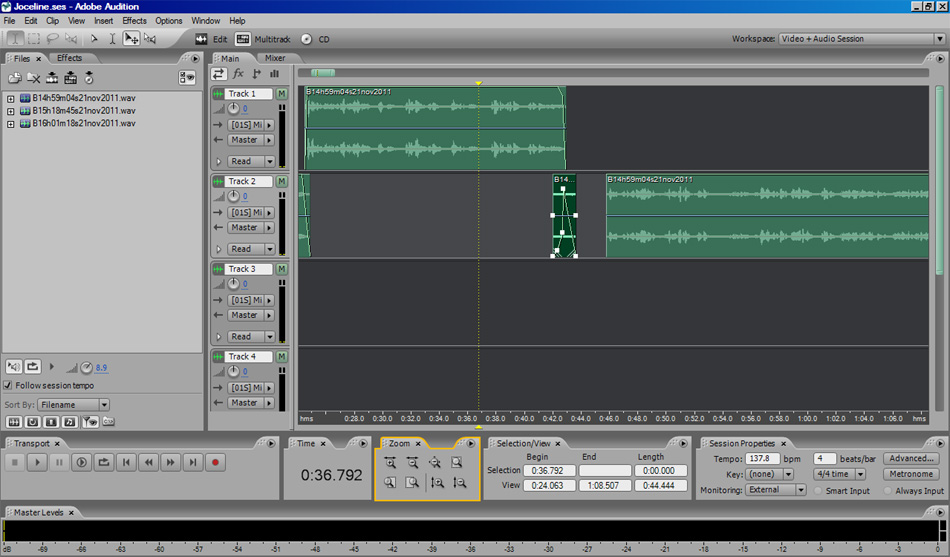
At the moment it looks like this:


What you see are several tracks of audio. The top 2 tracks are from one interview; the third and fourth layers down are from another; and the fifth line down is from the interview which I edited earlier on today. I have colour-coded all of the clips for the wallpaper samples, assigning one specific shade per wallpaper design, so that I have some way of visually arranging and grouping clips together.

To have reached this stage, I first of all imported individual interviews into the Multitrack view, (1 interview per 2 Audio tracks). I then named each track after the person/people speaking in that particular interview. At a glance I can see whose interviews I have processed, and which ones are still waiting to be done, and by keeping different voices on different tracks, it is easy to see who is speaking at any one time.


You'll notice that when an interview is first brought into the Multitrack view, it is all one colour and just looks like a giant waveform. In that state, it is very difficult to use; there is no way of telling - at a glance - which section of that long, rambling conversation relates to which piece of wallpaper. In order to begin clarifying what's what, I begin by muting all the tracks above, so that I am just listening to a single track, containing the new, imported audio.


As I listen, a very precise white cursor travels over the soundwave, and I can zoom in or zoom out to get a closer look at the sound signal. With this particular example, at this point in listening, I realise that everything to the left of the cursor is just me introducing the project, chattering away at Colleen and Annie, and rustling about as I begin taking wallpapers out to show them. I do not need any of this audio of me just banging on about the project; what I want to keep is people's natural responses to the wallpapers. So as my bit of introductory guff is coming to a close, I stop the cursor and press Ctrl+K, which splits the clip. I can then just delete the unwanted audio of me talking and banging around with the wallpapers from the Multitrack view. What is great, however, is that if I decide in the future that actually I want some of my rambling or wallpaper-rustling back in, then I haven't deleted it from the original file, just from this Multitrack mix. Does that make sense? I have excised the unnecessary audio from the track without actually destroying it, and that is the beauty of non-destructive editing.


I continue listening, and realise that the next section relates to a particular wallpaper design. I listen through to that, and I split the clip at the end, so that it is now a discrete little snippet of sound. I'm not going to do a precision-edit on it at this stage, but I will assign it a specific colour, so that it can be put with other people's discussions of that design. To do this, I check my private notes about the wallpaper designs to find the right colour.


You'll notice that I have given all the papers descriptive terms which I can remember, and which do not necessarily relate to the formal names of any of the papers! The naming of the papers - although it might not be best-practice from a traditional conservation point of view - is an important stage in terms of developing the sound pieces which will go with the samples.

The names reflect the character that different designs have taken on through the interview process; "blue/white starburst", "nervous system" and "sea-creature-purple-ness" are names derived from things people have said, from ideas and flights of fancy inspired by looking at wallpapers. Consulting the list, I see that the clip-colour I have assigned to the wallpaper design currently being discussed in the audio is 154, and so - having neatly isolated this segment of conversation from the rest of the audio using the Ctrl+K command - I now colour that clip with 154.


When I have gone through the entire interview, splitting and colouring every section in this way and cutting out anything which is unusable, I will have something resembling the fourth layer down; a long stretch of audio, cut up and coloured into different shades. Next, I shall match up the different sections with the sections above, putting like with like, so that all the audio relating to each wallpaper sample gets grouped together.


It takes time, and a lot of shuffling around... and at times it feels a bit like doing one of those impossible jigsaw puzzles. Some of the shades are very close together, so clips must sometimes be heard through a couple of times to make sure they are in the right place, with other clips relating to the same design...


...but these segments - these snippets of sound being heard and re-heard as they get moved around - are giving me ideas.

"it reminds me of my Grandmother's House" "it makes me feel sick" "it reminds me of my brother's matchbox car" "that one says 1970s carpet to me" "that one reminds me of a jewellery box and the sounds of the pearls sliding through your fingers" "I would have that on the end wall of an indoor swimming pool"

In this way, the editing process has an important, imaginative role in the development of the project. It is not only a process of clinically organising the interviews into manageable chunks, but also a process of fantasising and extrapolating; of "auralising", if that can be a word. As I listen and shuffle, I am quietly compiling a list of the sounds which might be recorded for this project, to contextualise and augment interviewees' comments on MoDA's wallpaper collection.

Things I could record: Aquariums, swimming pools, heavy costume jewellery, fuzzy felt and velcro, the ambience in an Indian Restaurant, the sounds of creaky old stairs, an owl in a tree; a very old set of stairs; jellyfish in the London Aquarium (would that even make a sound?)

People's words in my ears give rise to sonic pictures, and so although the process of organising the interviews is visually a little monotonous (even with the colours) putting them in order is essential to the thinking process that accompanies the creation of Sonic Wallpapers.


Practically speaking, once the sections are organised into groups so that all the clips relating to one design are together, I can export one giant wav-file of the whole project, and then cut this up into even tinier pieces, so that at the end, all the chaff is gone, and we are left with the kernels - the good wheat - of the interviews. I will then take these words, and record sounds with which to contextualise them, so that some of the richness of what is imagined when we consult old wallpapers - memories, associations, dreams of home and domestic creativity - might be transmitted to you in sound.


...At least that is the theory.


I would love to hear the experiences of other artists working with sound; how do you find the editing process? How important is editing to the development of an idea? How do you work with sounds/ideas when you are sorting through a whole load of audio?

Thursday, 19 January 2012

Editing notes

I am currently spending a lot of time walking and listening, and editing and listening.

This is what I can see when I am editing:


...and today, this is what I can hear:

Sonic Wallpaper Sample #1 by FelicityVFord

The words and thoughts of the interviewee make me think of the sounds of:

small rooms
creaky chairs
harp-strings
the sound of a tissue-box guitar, made with rubber bands
looms clacking

...all organised into a repetitive, minimalist composition. Lots of little sounds, repeated over and over, in a calming yet quite busy sequence. What sounds does this interviewee put into your head?

And which of the papers below do you think this small soundbyte relates to? Leave a comment to share your thoughts.


Wallpapers, shortlisted for Sonic Wallpaper interviews. Wallpaper © Museum of Domestic Design & Architecture, Middlesex University – photographed by Felicity Ford

Tuesday, 29 November 2011

Talking about Wallpaper

Conducting the interviews for the Sonic Wallpaper project was a rich and thought-provoking process. I am grateful to everyone who participated and shared their responses to the wallpapers I'd short-listed from the MoDA collection


Annie, Colleen and Felicity discussing wallpaper at MoDA; image © Richard Lumb and used with the permission of MoDA

I learnt through the interviews that when we discuss wallpaper in terms of atmospheres and memories - and not purely in terms of designs, fashion and history - powerful narratives emerge. The agency, imagination and creativity of the home-maker become apparent when he/she is presented with wallpapers and combines this with their experiences of homes and rooms and life lived therein. Through a process of considering and responding to wallpapers, a design which at first glance appeared bland or unassuming became a canvas on which to project the memories of a flat once lived in; a forest-like pattern inspired fantasies involving woodland and the quiet stillness of a chilly Autumn morning; a psychedelic print evoked the vision of a party where everyone is a bit shallow and stylishly posed; and bold, blousy flowers inspired a discussion on showing off, intimidation and social-climbing.


Wallpapers, shortlisted for Sonic Wallpaper interviews. Wallpaper © Museum of Domestic Design & Architecture, Middlesex University – photographed by Felicity Ford

As we talked, the pile of wallpapers became a repository of domestic dreaming, memories, wishes, observations, and polemic. Mundane memories were also evoked; the recollection of an irritating paper which wouldn't hold the wallpaper paste properly surfaced, along with another person's nightmarish memory of trying to scrape Artex off a ceiling.


Joceline considering wallpaper at MoDA; image © Richard Lumb and used with the permission of MoDA

Exploring MoDA's wallpapers also revealed desires for certain kinds of domestic spaces. Yearnings were exposed for spaces such as a garden room where there are plants and light to sit amongst; a room specifically allocated for the creation of chutneys and preserves; and a writing attic, where inkwells, pens and crisp cartridge paper a stacked inside a bureau. These longings were detailed, rich, complex and imaginative, connecting a sense of self with the organisation of domestic space.

I was amazed by how exploring the wallpapers at MoDA through the Sonic Wallpaper interview process frequently transgressed from a discussion re: wallpaper into questions concerning lifestyles and domestic activities.


Tom consulting the wallpapers. Wallpaper © Museum of Domestic Design & Architecture, Middlesex University – photographed by Felicity Ford

The next phase of the Sonic Wallpaper project will involve developing these narratives through sound, to create Sonic Wallpaper. Interviews will be edited and developed into sound pieces so that the thoughts and spaces imagined by interviewees can be conveyed to new audiences, and used to add depth and fresh perspectives to a touring exhibition of MoDA's wallpapers. I am very excited about this phase of the project and about translating the rituals of home-decorating into audible content and wallpaper you can listen to!

Sound can describe memories, eras, times and spaces in ways that pictures and images can't. While you can look at a floorplan or indeed a sheet of wallpaper and "visualise" how a space will appear, it is only when you hear a recording of walking through the space papered with it that you might begin to understand how air and molecules resonate within that space, or even how long the experience of walking through it might take.

Memories can be contained in the passing minutes and hours that a sound-recording captures. You can look at something in the blink of an eye but the blink of an ear is slower and we do not hear in snapshots. Soundwaves move from wall to wall inside our living rooms, capturing the size and depth of those spaces, the quantity and nature of the furnishings within and so on. So my challenge now is to conjure - in sound - the rooms, spaces and atmospheres which my interviewees have described, through a series of field-recording exercises, so that their descriptions relate to a Sonic Wallpaper or a Sonic sense of space, and not merely to wallpaper as a visually-designed aspect of home-decorating.

Some people describe imaginative listening as a process of "auralisation," an aural equivalent to "visualisation," whereby we imagine places acoustically, rather than picturing them. I like that idea. I look forward to listening to and recording such things as the drips of moisture falling inside a conservatory; the round, glassy sounds of stacking jars against one another on a sturdy wooden shelf; and the delicate, wet scratchings of a pen against paper in a tiny attic. There will be other sounds, other spaces to "auralise" and they will be revealed in little glimpses here, throughout coming weeks.

The next phase of the project will involve my putting all our conversations onto my iPod, and walking around for days at a time listening over and over to the interviews. I shall reach for the ear's imagination, and try to imagine the soundscapes attending my interviewees' fancies and discussions regarding domestic space. The wallpapers which end up in the final MoDA collection will be selected according to the Sonic Wallpapers which they have inspired, and the experience we create for exhibition-goers will be led by this, rather than by a desire to showcase the most arresting visual designs.

That was the most interesting revelation from the Sonic Wallpaper interviews; I learnt that the most arresting visual designs are perhaps not always the most interesting from the perspective of how we imagine and consider and remember and create our domestic spaces. It is the creativity of the home-maker and the imagination of the resident in domestic space which I hope to reflect in my Sonic Wallpaper designs, because those rich things are what you find when you scratch the surface of wallpaper and search for what is underneath, and they - for me - are best described in sound.


Tom and Anthony with their favourite wallpaper designs, respectively to decorate The Study, and The Beatnik Bedroom. Wallpaper © Museum of Domestic Design & Architecture, Middlesex University – photographed by Felicity Ford

Wednesday, 9 November 2011

on the Conservation of wallpapers

The conservation of vintage wallpapers lies rather outside my own areas of expertise, but I am very interested in maintenance tasks and also in the secret life of material things, therefore I learn from - and enjoy - observing how the important objects and materials at MoDA are maintained and conserved by the Staff there.

In selecting wallpapers to show to the public in the Sonic Wallpaper exhibition, it is essential that what we choose can withstand the pressures of being framed, travelled around, and exposed to light. Emma Shaw discussed with me last week how inherently ephemeral and fragile wallpaper is, and explained a bit about how samples must be prepared for display.

Some sections of wallpaper in the MoDA collection are still in rolls and need to be flattened. These include a design which features stone arches in a kind of faux architecture pattern, and a flocked paper.


Wallpaper © Museum of Domestic Design & Architecture, Middlesex University – photographed by Felicity Ford

The flocking process is apparently very involved, and results in many delicate fibres poking directly upwards from the paper. These fibres can be easily crushed or damaged, so it is important that if weights are applied to the surface, that this is done carefully and that something is done to protect the flocking.


Wallpaper © Museum of Domestic Design & Architecture, Middlesex University – photographed by Felicity Ford

To flatten the flocked wallpaper I am hoping to include in the Sonic Wallpaper project, Emma Shaw - who is the Preventative Conservation Officer at MoDA - laid 2 heavy sheets of blotting paper on top of it, and then a thinnish sheet of glass on top of them. The resulting "sandwich" now sits on a worktable in the conservation room, where Emma will periodically check up on it, until it is flat.


Wallpaper © Museum of Domestic Design & Architecture, Middlesex University – photographed by Felicity Ford

The other design will be flattened by applying through fine misting using a dahlia spray. The moisture will cause the fibres in the paper to relax, so that it will flatten out easily.


Wallpaper © Museum of Domestic Design & Architecture, Middlesex University – photographed by Felicity Ford

What I especially liked about watching Emma fix up the papers - and listening to her speak about the process - was the sense of methodical and necessary labour. These kinds of tasks are absolutely essential for the preservation of anything old or delicate, and experts all over the country right now are performing routine tasks of maintenance and conservation on things so that we may continue to enjoy and see them long into the future.

The sounds in the recording I have published here are of myself and Emma discussing the conservation work; of the hum of the air-conditioning in the conservation room; and of the materials involved in preserving the wallpaper. I like the recording for its quiet sense of industry, and for the way it evidences materials and tools and the preservation of the past.

Emma Shaw conserving Wallpaper samples at the Museum of Domestic Design and Architecture (mp3)

Tuesday, 8 November 2011

Process

One of the things I find essential to developing an idea, is physically coming into contact with things and materials. Objects are something that we think with, and it is my experience as an artist that actually handling, hearing and smelling them in 3-D reality is as central to the imaginative process as seeing them (in spite of Art History's obsession with the visual). Luckily for the sake of this project, handling the objects and responding to them is allowed, although gloves must be worn in the study room for conservation purposes.

I have now spent two happy sessions at MoDA shortlisting from their enormous collection of wallpapers to find samples suitable for the Sonic Wallpaper project. This began as a rather intellectual exercise, with me thinking that we should choose wallpapers in different categories - abstract, figurative, floral etc. - but discussing the papers with Maggie and Emma during my visit last week, and also handling a whole new batch of different samples, has shifted the direction just slightly. Rather than presenting interviewees of the Sonic Wallpaper project with a mix of categorised samples, I have devised a series for the interviews which will hopefully take visitors on a journey from fairly recognisable and familiar papers, through to the examples of wallpaper in the MoDA collection which are going to be more fantastical to contemporary eyes and home-making sensibilities.

During my encounter with the MoDA collection last week, I found that papers with recognisable designs on them - papers which I could easily associate with relatives' homes and childhood memories - immediately opened up a remembering/imagining state of mind, whereas papers with extremely fantastical or brightly-coloured imagery on them inspired more fanciful and less domestic thinking processes. I am beginning to find it more and more helpful to relate the stages of this project to the stages of actually decorating a room; to immerse myself in all the contexts which surround the relatively everyday ritual of decorating a room.

In my imagination, this project is like a room, and we are picking the right papers for it, based on the responses I am imagining they may evoke; it's not so different at all from decorating a bedroom or a kitchen; except that the 'room' in question is not a space made for sleeping and cooking in, but an imaginative dimension, in which the wallpaper used must be made accessible and inspiring to the people who are going to consider and look at it.

Emma Shaw - who is the Preventive Conservation Officer at MoDA - also made a helpful suggestion during my visit regarding how the wallpaper samples will eventually be displayed. Up until my visit last week, I had been thinking about the project purely in terms of SOUND, and in terms of voices and field-recordings leading viewers and listeners through an imaginative contemplation of wallpaper. However after talking to Emma about the final exhibition that this project will become, I realise that even for this stage of the project, wallpaper samples should be organised as a journey through ideas rather than in themed groups. This is the kind of discovery that you can only make by physically walking through an idea; in this case, through taking sample after sample out of box after box and looking at each one critically, with the hands, eyes and imagination, and wondering where it fits, what it links to, how it will make people feel, what it means and how - in its physical state - it suggests or describes an environment with attendant sounds.

Obviously I can show you this image of wallpaper - one of the many samples which I consulted last week at MoDA as part of this project - but I will have to work a little harder and grapple with language and memory to try and convey the impact that encountering it as an object had on me and therefore how I imagine it will - as an object - give ideas and associations to the people who have agreed to be interviewed as part of this process:


Wallpaper © Museum of Domestic Design & Architecture, Middlesex University – photographed by Felicity Ford

There are many aged fragments of paper like this one at MoDA, bearing familiar rose and trellis patterns, fragile corners and edges darkened by the passage of time. Some of them seem very small, offering just the merest glimpse into the thoughts somebody once had about a room they were decorating. The ephemeral nature of wallpaper means that older fragments feel particularly fragile, as though one is holding just a tiny remnant left over from somebody's domestic space.

In terms of the sounds this fragment makes me imagine, I found the act of sifting through papers and looking at them at MoDA to be reminiscent of the quiet, focussed discussions we have in rooms together, standing and assessing and imagining what a space might look like after we have transformed it. These particular papers with their roses and warm, pinkish tones are full of memories of girlishness and a kind of self-conscious aspiration to femininity. The associated sounds I imagine while looking at it are very soft and delicate; a pink powder puff I once had in a tin with a rose pattern on the top; the gentle "shhh" as lining-paper is smoothed into a clothes drawer; the sound of heavy drapes being closed across a window at night; the muffled space inside a duvet; the distinctive sound of pearls being replaced or removed from a jewellery box. These for me are very quiet papers connected to the entire idea of The Boudoir, or perhaps - even more personally - to my own former, self-conscious, suburban, teenage-girlhood appropriation of that idea.


Wallpaper © Museum of Domestic Design & Architecture, Middlesex University – photographed by Felicity Ford

I also found myself looking at several designs which were the same pattern, but which utilised different colour schemes. This made me think about colour discussions and how emotional our responses to different colours tend to be, especially regarding how they change the atmosphere in a room.

Several selections where the pattern is the same, but where the design comes in a whole range of different colours have therefore been incorporated into the Sonic Wallpapers shortlist. I am wondering how interviewees will respond to the effects of colour changes on designs like this...


Wallpaper © Museum of Domestic Design & Architecture, Middlesex University – photographed by Felicity Ford


Wallpaper © Museum of Domestic Design & Architecture, Middlesex University – photographed by Felicity Ford

All of the handling of wallpaper and the consideration of the viewers' experience which I am shaping here for the interview days towards the end of the month put me slightly uncomfortably in touch with the fear that I might be choosing very poorly from the collection, or displaying a horrendous ignorance about the history of wallpapers in my selections, but these emotions are entirely appropriate to the process of choosing wallpaper itself, and are in a sense native to the entire context of the wallpapering of space. As Christine Woods writes in her excellent introduction to "Walls are talking, Wallpaper, Art and Culture";
Depending on the rules of the time, the hanging of particular styles of pattern displayed either the consumer's awareness of current fashionable taste or their innate vulgarity. Choosing wallpaper has always been a tricky business, and our feelings towards it have always been ambivalent. From small beginnings as a decorative novelty for the middle and upper classes, through its controversial passage as a carrier of noxious vapours and instigator of mad episodes, wallpaper has become both the silent witness of and active participant in Western culture, acting as an important social and cultural signifier. In regarding paper as nothing more than 'white noise' we allow ourselves to ignore rather than address its power.

I love that in that quote, Woods labels precisely the fears surrounding, and also the ubiquity of, wallpaper in our culture. I obviously also enjoy her sonic simile, in which Wallpaper has historically been considered to be a kind of 'white noise', being both present and also disregarded or easy to filter out.

As the process of exploring wallpaper in my own distinctive, domestic soundscape fashion develops, I am excited to see what happens when we bring that 'white noise' to the fore via the production of clear, distinct sound-works, and in continuing to allow these wonderful materials at MoDA to lead the way.

Friday, 21 October 2011

Your Sonic Wallpapers; ideas from you

In this post I would like to respond to some of your wonderful comments on my own blog relating to this project, and also on some of the sound descriptions and images that you have added to the Sonic Wallpaper Pinterest board.

I love Mikal's ideas for a Sonic Wallpaper based on this Sanderson Woodland Ferns wallpaper.


Mikal wrote about the soft patter of rain dripping on leaves as a kind of aural equivalent for this delicate, silvery pattern.

There is something understated about the idea of this sound... it is a gentle sort of sound sonically resembling the muted palette of the paper's visual design. (Click here to see.)

Reading Mikal's words made me think about the sounds of water, and of this paper in the MoDA collection, which somehow suggests to me the gently humming drone of an aquarium.


Wallpaper © Museum of Domestic Design & Architecture, Middlesex University – photographed by Felicity Ford

What sounds does it make you think of?

I also enjoyed Mikal's comment about the added tactile dimension of flock wallpaper (image can be seen here). Flocked, Sonic Wallpaper could be heard, touched and seen.


It was interesting to try and imagine in my mind's ear what a brassy and bold sonic equivalent to this flock paper might be, and I kept thinking of long, sustained, shifting chords played on brass instruments. What do you think?

Tom left an amazing comment on my blog, regarding the idea of meta Sonic Wallpaper; i.e. Sonic Wallpaper which references the intended use or functions of a room;

I was thinking about meta-sounds: e.g. for the kitchen, you’d have the kettle coming to the boil, something simmmering on the hob, the chopping of vegetables, the clanging of utensils. For the lounge the rustling of newspapers being turned (although, when was the last time I read news in the PAPERS? I get it all from the interent now), some music in the background. Sitting down into that sqeaky chair. At dusk, the swishing of curtains closing.

But trying to expand this into other rooms would perhaps not always work. Who would want to go into the smallest room and then you’d hear the noises of somebody “doing their business”? (this reminds me: when I lived in a shared house as a student, we taped Beavis & Butthead episodes onto cassette tapes and we wired a walkman with speakers into the light switch, so each time you switched on the light you heard “huhuhuhuh. hey beavis. huhhuhuh. cool. huhuhuh”. Our own sonic wallpaper!) And let’s not even begin pondering the bedroom noises.

On the other hand, you could turn things upside down by playing the sounds you’d associate with one room, in another room. A surrealist decoration!


This is interesting to me in many ways - firstly, who doesn't LOVE the domestic creativity involved in rewiring the lights?! Secondly, the idea of surrealist sonic home-decoration is most intriguing; what bizarre play could be had by exporting unexpected sounds from one context into another? For instance, what would it be like if opening kitchen cupboards resulted in the sound of a swarm of bees rushing across some carefully placed speakers, panning from left to right, as if moving? Or if you installed the sound of some pigs grunting deep into a dark corner of the house?

Grunting pigs, Mudchute City Farm (mp3)

I also love the amusing way that Tom describes the intimacy of home spaces and refers to the kinds of sounds which we would rather keep private, or not hear, and certainly not record.

The sounds Tom has focussed on as being the sounds of domestic space are lovely in their details - a curtain closing; a newspaper page turning. And many visually designed wallpapers work like this, echoing details of domestic life in imagery. How many kitchen wallpapers have you seen for instance depicting cookware or food items?


Wallpaper © Museum of Domestic Design & Architecture, Middlesex University – photographed by Felicity Ford

Why not create an audible equivalent? It might be confusing to distinguish between the recorded sound of the toaster and the actual sound of the toaster, but maybe this is part of the domestic play and creativity inherent in the idea of Sonic Wallpaper. Perhaps it will be possible in the future to buy Sonic Kitchen Wallpaper featuring - as Tom suggests - the sounds of slicing, dicing, bubbling, boiling, and perhaps the merry whistling of a contented chef. Or perhaps my own favourite kitchen sound - the climactic bubbling of the stove top espresso-maker.

Italian stove-top coffee maker (mp3)

Echoing the delicate soundscape of Mikal's imagined Sonic Wallpaper, Emmylou described how some of her favourite sounds involve rain;

I like the sound of rain; on tents or on my glass skylights, especially in the dark and warm. It also smells good so that is an added bonus.


Rain on a tent (mp3)

Emmylou also raised some important points about how the context in which we hear sounds is a huge factor in how we experience them. Discussing a motorcyclist who travels around the Reading IDR very fast late at night, she mentions how the sound - in her words a good noise - induces a feeling of panic in her when she hears it in the context of the late night, dangerous driving. This reminds me of when I interviewed Motor cyclists at the H Cafe for my radio show about the A4074 road and found that the sound of one's engine is a source of pride and interest to bikers, but that in some other contexts - such as the one Emmylou describes - this same sound has different, darker connotations.

bikers at the HCafe on the A4074 (mp3)

Mark found a very ornate wallpaper featuring monkeys.


...he elaborated on a correspondingly playful and exuberant accompanying soundscape;

sounds of a school playground at lunchtime, the rustling of beasts in the undergrowth, things falling to the pavement from the canopy above.


I like the specificity of lunchtime playground sound - a sound which often drifts across from schools at around midday, and which is filled with excitement, outrage, chattering and squealing. The idea of rustling and things falling to the pavement is also nice - especially if what is falling is fruit. The luscious depictions of fruit in Victorian wallpapers, for instance, have a grandeur and a silence which would be very much undermined by the unserious squelchy noises of a kiwi fruit splatting onto the pavement, or the dull thud of a melon splitting open.

I also enjoyed the brashly militaristic connotations of this other wallpaper chosen by Mark for the Sonic Wallpaper Pinterest board from this blog post on vintage, 1970s wallpaper samples;

before the war - the pipes and drums of the parade, cheering crowds, the buzz of anticipation, clip clop of hooves on cobblestones, orders barked and obeyed in unison, the sounds of control...


It's interesting to me that some of the sounds in that list seem slightly old-fashioned, like the horses' hooves on cobblestones. Perhaps this mirrors in some way the vintagey, old-timey feeling of the visual design of the paper...

Finally I want to thank Chris for this lovely description of the sounds of a rookery;

There is a rookery in the beech trees here. They have their routines but craw time about an hour before sunset when they return home in commuter uproar and later when they are settling down in drowsy conversation are both full of reassuring sound. They seem to like having humans around the place.


The word "craw" is so descriptive of the dark, throaty sounds a crow makes, don't you think?

birds at Ipsden (mp3)

What is especially interesting in Chris's description is the allusion to time. While printed paper wallpaper is static, and while its design does not change, sounds do shift, change and develop over time. Like the crows whose sounds have a distinctive sequence, so too does the rain on a tent; the march of a band; the buttering of a piece of bread; and so on. They are all sequences of events and this leads me to wonder what the timescale of Sonic Wallpaper could/should be. Should rolls be an hour, a week, a day, a month, a year or a minute long? I guess it depends on who is decorating.

Thank you so much to everyone who has contributed already to Sonic Wallpaper!
You can follow the project on Facebook, Pinterest and Twitter, and if you want to join the Pinterest board, leave a comment here and I will make it possible.